You need one conversion — 2 kg to lb — and Google answers it inline before you finish typing. Then you need three more: an oven temp in Celsius, a fabric length in yards, a laptop spec in GB. Now you're four tabs deep, and you still had to look up whether a "ton" means the same thing on both sides of the Atlantic.
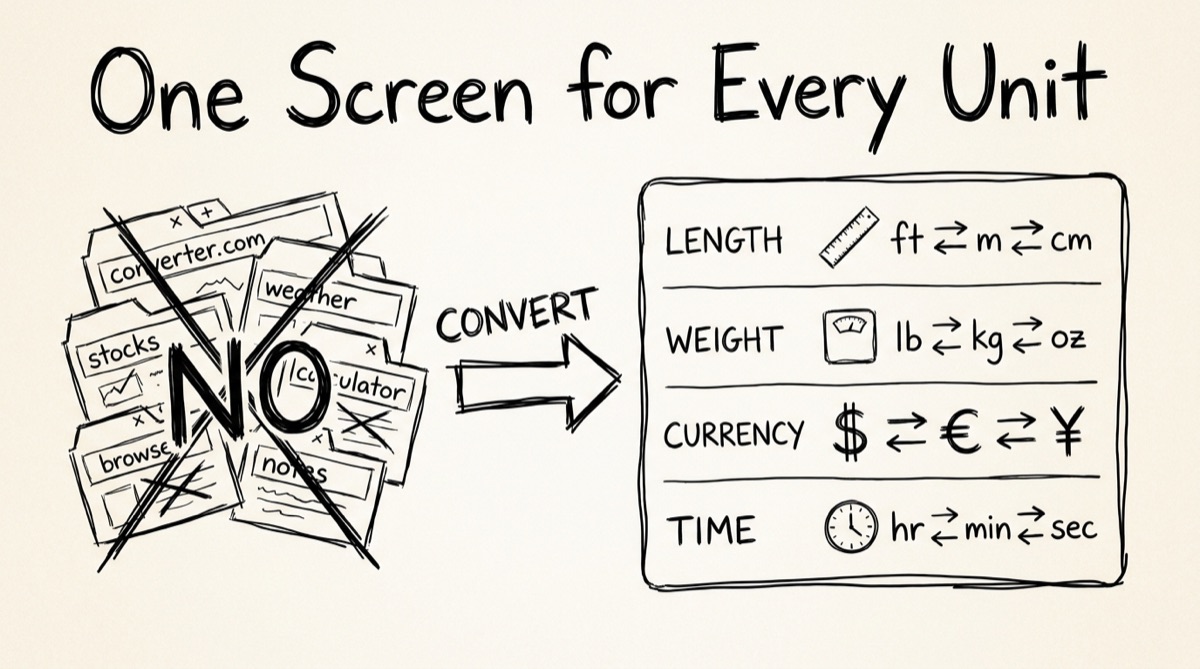
Most unit mistakes aren't math errors — they're unit-definition errors. You multiplied correctly; you just used the wrong gallon. This guide covers the conversions that actually trip people up, a table of the ones you'll look up most, and how to do all of it on one screen with orangebot.ai's unit converter.
The Conversions People Actually Get Wrong
Fluid ounce vs. ounce. A fluid ounce (fl oz) measures volume; an ounce (oz) measures weight. They only line up numerically for water-like liquids — an "8 oz" recipe measurement assumes 8 fl oz of something close to water's density, which breaks down fast for oil, honey, or flour. The two units live in different categories on purpose: fl oz is under Volume, oz is under Weight.
US gallon vs. imperial gallon. A US gallon is 3.78541 liters. An imperial (UK) gallon is 4.54609 liters — about 20% bigger. Fuel economy figures, recipe yields, and tank capacities quoted in "gallons" from UK or Canadian sources are not the same gallon as US sources. Any converter that just says "gallon" without specifying which one is a trap; orangebot's Volume tab labels it explicitly as US Gallon so you know which system you're getting.
Cooking cups by country. A US customary cup is 236.588 mL. A metric cup — the one used in most Australian and many UK recipes — is 250 mL. A US "legal" cup, the kind used on US nutrition labels, is 240 mL. That's a 5% spread. Small in a glass of water, enough to throw off a baking ratio. Same story with the cup unit: labeled US Cup on purpose, not just "cup."
Metric ton vs. short/long ton. A metric tonne is 1,000 kg. A US short ton is 907.185 kg (2,000 lb). A UK long ton is 1,016.05 kg (2,240 lb). Shipping and cargo weights quoted in "tons" from US sources are usually short tons, not metric. The tool's ton unit is explicitly the Metric Ton — worth double-checking against your source before assuming they match.
Stone. Still the standard way UK and Irish sources report body weight. 1 stone = 6.35029 kg = 14 lb. It's easy to forget this exists until you're reading a UK weight and the number looks implausibly small.
Knots vs. mph vs. km/h. A knot is one nautical mile per hour — 1.852 km/h — and it's what aviation, maritime, and most wind-speed reports actually use, not mph or km/h. Reading a "40 knot wind" as 40 mph understates it by about 15%.
Byte math: 1 GB isn't always 1000 MB. This one's a real engineering fact, not a rounding quirk. Operating systems compute storage in binary — 1 KB = 1,024 bytes, 1 MB = 1,024 KB, and so on — which is exactly how orangebot's Data category is built. Drive manufacturers advertise capacity in decimal (1 KB = 1,000 bytes), which is why a drive sold as "1 TB" shows up as roughly 931 GB once your OS mounts it. Neither number is wrong. They're two competing standards for the same unit name, and most converters don't tell you which one they're using — this one does, because it matches what your file manager already shows you.
Time units are elapsed durations, not calendar dates. Worth knowing before you trust the output: the Time category defines a month as a flat 30 days and a year as a flat 365 days, for straightforward elapsed-time math (seconds to hours to weeks). It doesn't account for actual month lengths or leap years — fine for "how many hours is 3 weeks," not a substitute for calendar arithmetic.
Quick Reference: The Conversions People Search For Most
| Convert | Factor | Example |
|---|---|---|
| Miles → Kilometers | 1 mi = 1.60934 km | 5 mi = 8.05 km |
| Feet → Meters | 1 ft = 0.3048 m | 6 ft = 1.83 m |
| Inches → Centimeters | 1 in = 2.54 cm | 10 in = 25.4 cm |
| Pounds → Kilograms | 1 lb = 0.453592 kg | 150 lb = 68.04 kg |
| Ounces → Grams | 1 oz = 28.3495 g | 4 oz = 113.4 g |
| Stone → Kilograms | 1 stone = 6.35029 kg | 12 stone = 76.2 kg |
| Fahrenheit → Celsius | C = (F − 32) × 5/9 | 100°F = 37.8°C |
| US Gallons → Liters | 1 gal = 3.78541 L | 5 gal = 18.93 L |
| US Cups → Milliliters | 1 cup = 236.588 mL | 2 cups = 473.2 mL |
| Gigabytes → Megabytes | 1 GB = 1,024 MB | 4 GB = 4,096 MB |
| Acres → Square Meters | 1 acre = 4,046.86 sqm | 2 acres = 8,093.7 sqm |
| MPH → Km/h | 1 mph = 1.60934 km/h | 60 mph = 96.6 km/h |
How to Convert Units with OrangeBot's Converter
- Open /tools/unit-converter and pick a category. Tabs across the top switch between Length, Weight, Temperature, Area, Volume, Speed, Data, and Time — no page reload, no separate URLs to hunt for.
- Type a value. Decimals and negative numbers both work — negative matters most for Fahrenheit and Celsius, which both go well below zero.
- Pick source and target units from the dropdowns next to each field. Every unit label is explicit about which system it belongs to (US Gallon, Metric Ton, US Cup), so you're not guessing which "gallon" you're getting.
- Read the live result and the formula underneath it. Every conversion shows its factor (e.g., "1 mi = 1.60934 km") in place, so you can see the math instead of trusting a black box — and reuse the factor by hand later if you need to.
- Swap or jump to a shortcut. The swap button flips source and target instantly; the six "Common Conversions" cards below the tool (mi↔km, ft↔m, lb↔kg, F↔C, GB↔MB, gal↔L) jump straight to a preset with one click.
None of this touches a network. The badge under the headline — "Runs entirely in your browser" — isn't just privacy marketing here; none of the eight categories depend on a live feed (no currency lookups, no timezone databases), so the whole tool works with Wi-Fi off.
Unit Converter Options, Compared
Google's inline converter (typing "50 kg in lb" straight into the search box) is the fastest thing that exists for a single, one-off conversion — no click, no page load. Use it for that. What it doesn't do: show you the underlying factor, remember your last category for the next conversion, or handle an ambiguous unit gracefully. Try "1 ton in kg" and you get an answer with no indication of which ton it picked.
calculator.net's conversion calculator and unitconverters.net both cover more obscure units than any one-screen tool reasonably can — genuinely useful for something niche. The tradeoff is ad density and page weight, since both are built to rank for hundreds of long-tail unit-pair pages rather than to be a fast daily tool.
A dedicated one-screen converter wins on multi-category sessions. Packing for a trip, you're converting a weight limit, a temperature forecast, and maybe a room's square meters to square feet — three lookups elsewhere, one tab-click apart here. Every result shows its formula, so you're not silently trusting whether a "ton" answer used metric or short tons.
This isn't the only day-to-day math tool worth bookmarking alongside it. Timezones are a related but genuinely different kind of conversion — no fixed multiplication factor, since the answer depends on the calendar date and DST rules — so orangebot keeps that as its own tool at /tools/timezone-converter rather than bolting it onto a unit converter that doesn't need calendar logic. If you're moving and comparing square footage to square meters, our post on scheduling meetings across time zones covers the calendar side, and how mortgage payments are calculated covers the financing math this converter intentionally leaves out. The rest of the browser-based toolkit — no upload, no sign-up — is at /tools.
FAQ
Does it convert currency?
No. Every category here is a physical unit — length, weight, temperature, area, volume, speed, digital storage, and elapsed time. Currency conversion needs a live, constantly-updating FX feed, which is a different engineering problem with a different trust model (you'd have to trust whoever's serving the rate). This tool doesn't fetch anything from a server, by design, so currency isn't in scope.
What's the actual difference between a US cup and a metric cup?
About 5%. A US customary cup is 236.588 mL (what this tool uses), a metric cup common in Australian and some UK recipes is 250 mL, and a US "legal" cup used on nutrition labels is 240 mL. Small in a glass of water, enough to matter in a baking ratio.
Why does 1 GB show as 1,024 MB here instead of 1,000?
Because this tool uses the binary convention your operating system uses internally — 1 KB = 1,024 bytes — the same math Finder or File Explorer uses to report file and folder sizes. Storage manufacturers advertise drives in decimal (1 KB = 1,000 bytes), which is the entire reason a drive sold as "1 TB" mounts as roughly 931 GB. Neither is wrong; they're two different standards sharing the same unit name.
Is my data uploaded anywhere?
No. Every category runs as plain arithmetic in your browser tab. There's no fetch call and nothing logged, because there's no server side of this tool to log to.
Does it handle negative numbers and decimals?
Yes. This matters most for temperature — Celsius and Fahrenheit both go well below zero, though Kelvin (an absolute scale) can't go negative.
Can I convert timezones on this tool too?
Not by design. A timezone offset isn't a fixed multiplication factor the way a unit conversion is — it depends on the specific date and local daylight-saving rules, which is a calendar problem, not a unit problem. Use /tools/timezone-converter for that, and see Scheduling Meetings Across Time Zones if you're coordinating a recurring meeting across regions.